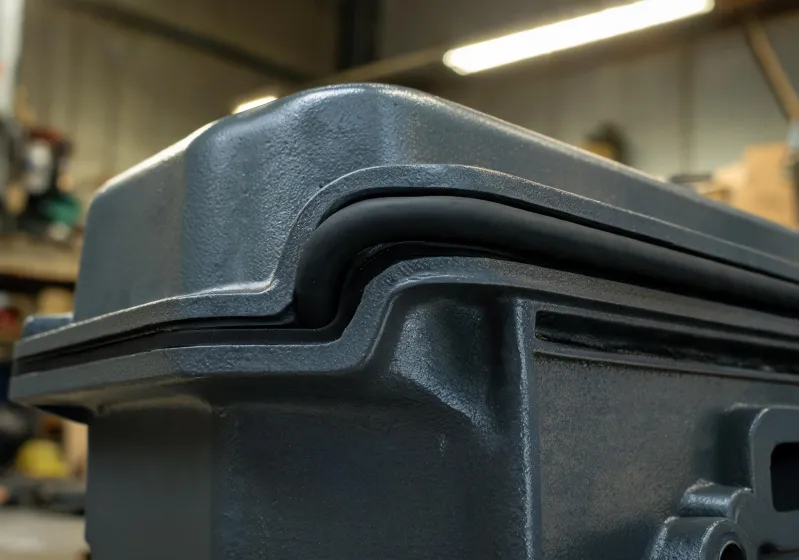
A rubber gasket seal request is a set of written conditions: medium, service temperature in °F or °C, size and Shore A. It is not a promise that the joint will hold after installation. Confirm those conditions on site before ordering.
What the installation is really asking
Flange and cover joints
The project is asking for a compressible face that matches the raised or flat face, not for a generic “seal”. Write ID/OD or the flange standard, thickness, and whether the medium is steam, water or oil.
On-site check: face finish, bolt pattern and the actual gap. A thicker blank is a different line.
Enclosure lids
The project is asking for a continuous path around a lid, often from die-cut sheet. Write closed-cell vs solid, Shore A, and whether IP language belongs to the enclosure or to the gasket.
On-site check: groove width and compression. Do not order from a photo of a painted box.
Pumps and process covers
The project is asking for oil, water or chemical contact at a named temperature. Silicone vs FKM is a medium decision: silicone for a wide dry-heat window; FKM when hydrocarbons stay on the joint.
On-site check: the fluid that actually wets the gasket, not the fluid on the nameplate of a neighbouring pump.
Custom outlines and replacements
The project is asking to copy a failed part. A competitor number is a reference the factory may or may not cross. Keep the original line on file and re-issue any changed axis as a new request.
On-site check: measure ID/OD and thickness of the failed part before sending only a photo.
Selector checklist before you order a rubber gasket seal
Tick only what you can confirm. Empty boxes stay empty on the inquiry.
Vulcanized rubber still wins where compression set and continuous heat sit above what a TPE over-mold can hold. Do not let a thermoplastic sample stand in for a crosslinked gasket without rewriting the request.
Send the application as purchase fields
We will not convert a use-case paragraph into a hardness or a size on your behalf.